How Intelligence Flows
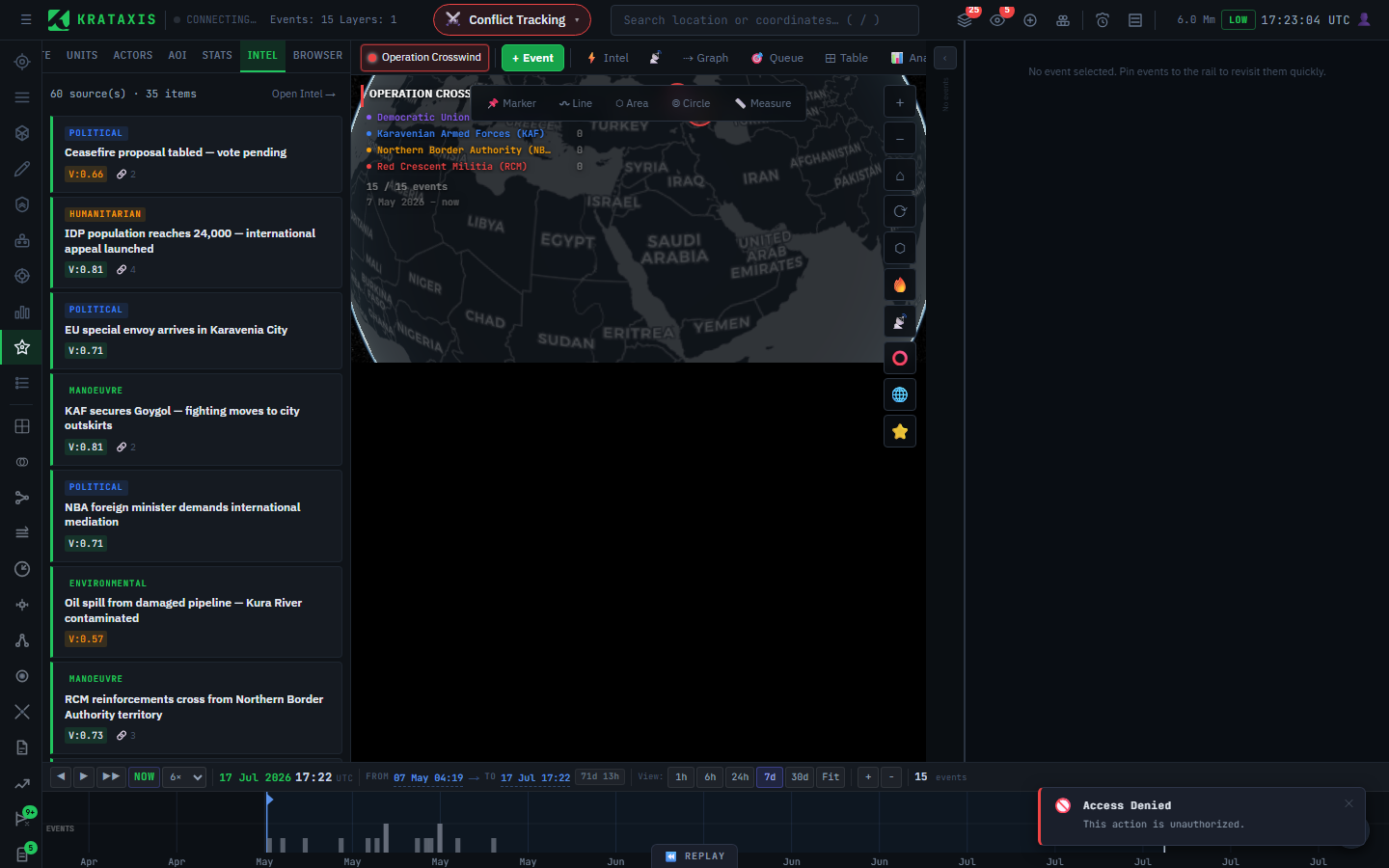
Krataxis exists to do one thing well: turn noisy, contradictory open-source reporting into a structured, weighted, spatio-temporal operational picture. Understanding how a raw claim becomes graded intelligence will make every other part of the platform read more clearly — because almost everything you see on the map is the output of this pipeline.
The whole flow can be held in one sentence:
Raw claim → normalised item → corroborated cluster → graded intelligence → human-confirmed assessment.
The governing principle is simple: confidence is earned as evidence accumulates. Nothing is assumed true on arrival. A single report is just that — a report. It becomes intelligence only as corroboration, location, actor context, and ultimately analyst judgement are layered onto it.
Journalism runs on the same rule. A single tip is a lead, not a story; the story runs when independent sources confirm it. The pipeline below is that editorial discipline, automated and applied to everything that comes in.
Where the data comes from
Krataxis draws from a broad base of trusted, verified sources — open web and news reporting, structured conflict-event datasets, humanitarian and environmental reporting, geolocated observation, and public-health reporting. You connect the sources relevant to your work (see Feeds & Sources); the platform reads each one and translates whatever it returns into a single, common internal shape.
That translation step matters more than it sounds. From the moment data enters, it stops mattering where it came from in format terms — a wire article and a structured dataset row become the same kind of thing. Everything downstream works on one consistent representation.
One shared shape
Whatever the original material, it enters as a normalised item carrying:
- a unified category (for example conflict, airstrike, artillery, humanitarian, disaster, political, protest),
- a severity on a 1–5 scale,
- an item type (event, marker, news, social, unit position),
- coordinates and/or geometry where available,
- a snapshot of how reliable the source is, and
- a record of why it was classified the way it was, so the decision can be reviewed later.
Think of it like an airport security line: whatever luggage people arrive with, everything goes through the same scanner and comes out tagged the same way. Because everything is normalised at this point, the rest of the platform reasons about intelligence, not about source formats.
Fusion: where intelligence is actually computed
Raw items arriving is only the start. A disciplined chain of analysis then turns data into intelligence:
- Link detection — relationships between new and existing items are surfaced.
- Relevance — each item is scored against your active battlespaces by geography, actor mentions, topic, and explicit assignment.
- Clustering — items describing the same real-world event are merged into a cluster. A cluster's size is a direct measure of corroboration.
- Actor resolution — named mentions are resolved to known actors, and roles (who acted, who was affected) are disambiguated.
- Deception detection — clusters showing signs of coordinated, manufactured consensus are flagged.
- Grading — each item gets a continuous validity score, and each cluster is placed on a credibility ladder.
- Enrichment — attached media, unit symbology, account vetting, and watchlist alerts are applied.
Step 3 deserves a highlight, because it's where the most common trap is defused. Three reports of one strike might be three independent witnesses — or one press release copied three times. Clustering merges the copies so that what counts is the number of genuinely independent voices, not the raw volume of text.
Grading is important enough to have its own article: Credibility & Validity.
Geometry, symbology, and territory
Spatial truth is first-class: items, events, and units carry real geometry and can be queried by proximity and containment. Conflict events receive a structured event code, units carry standard military symbology, and actors accrue territorial extents over time. These are covered in ESC Codes & Symbology and Actors & Territory.
The human in the loop
The pipeline is disciplined but not infallible. Items that score highly but don't meet the bar for automatic promotion land in the Analyst Review Queue, where an analyst confirms, rejects, or escalates them. Analyst confirmation is sovereign — once a person has decided, the automated pipeline never silently reverses it.
That is the whole philosophy in miniature: automate the grading of evidence at scale, but give the final word to a person. The machine is the junior researcher who reads everything and drafts an assessment; you are the editor whose signature goes on the page.
How to use this understanding
- When something appears on the map, remember it's the output of grading — check its credibility before you lean on it.
- A thin, single-source item and a heavily corroborated cluster look similar at a glance but mean very different things.
- If the picture seems wrong, the review queue and the evidence chain let you trace any item back to what it was built from.
Where to next
- Credibility & Validity — how the platform grades trust.
- Feeds & Sources — connecting the sources that feed this pipeline.