The Analyst Review Queue & Triage
The pipeline grades evidence automatically, and items that clearly clear the bar are promoted on their own. But the most important items are often the borderline ones — well-corroborated yet not quite certain, or carrying a signal that warrants a human look. Those land in the Analyst Review Queue: a single-screen triage surface where you make the call.
This is where the platform's core principle becomes concrete: automation grades the evidence; a person decides. Nothing the queue contains becomes confirmed truth until you say so. The arrangement is a lot like a hospital triage desk — the intake system sorts and prioritises arrivals, but a clinician makes the call on each one, and the clinician's decision is what goes on the chart.
Opening it
Click 🎯 Queue in the header. The queue can also dock alongside the map so you can triage without losing spatial context. The header badge shows how many items are waiting.
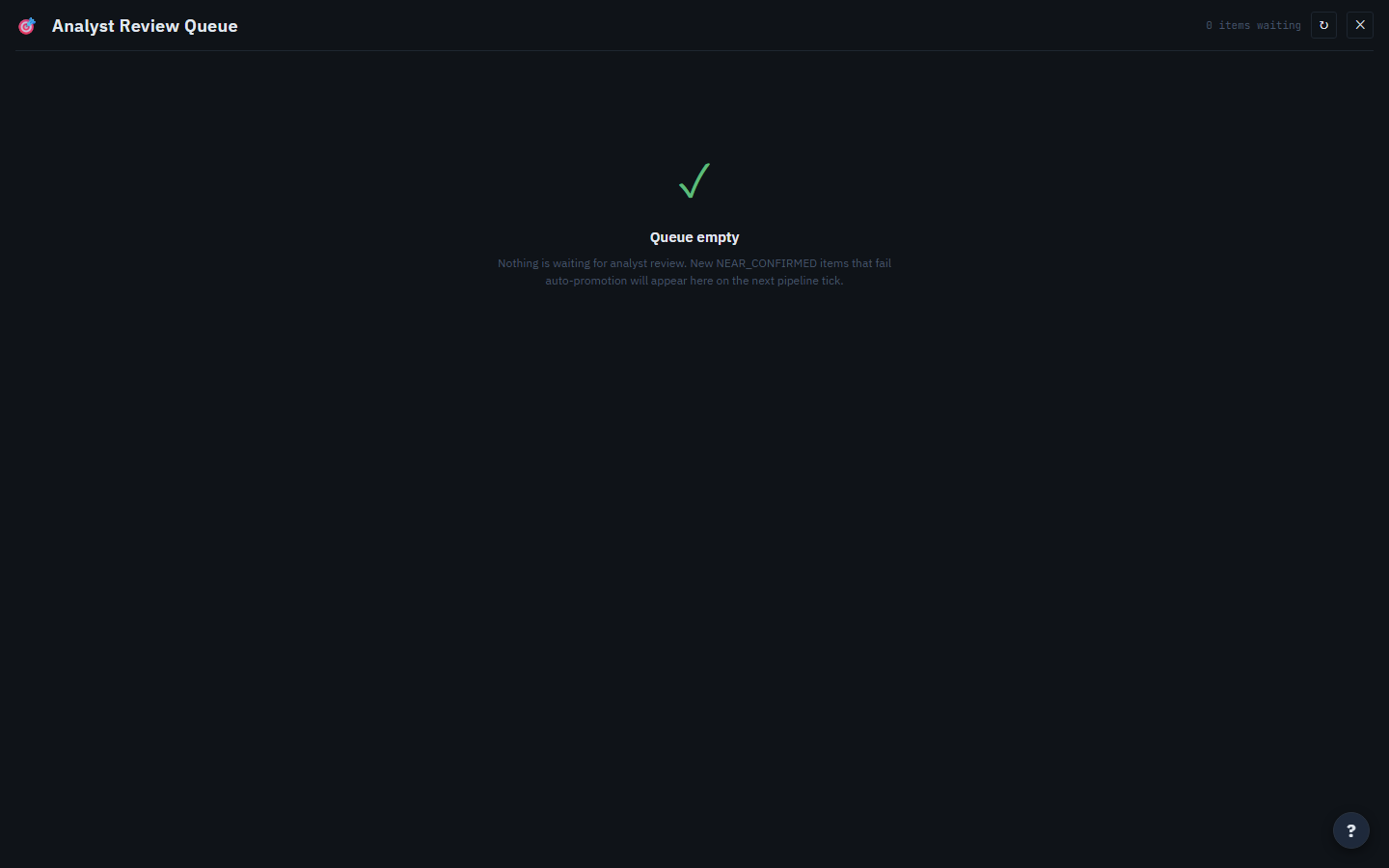
An empty queue is the normal, healthy state between pipeline updates — it means every borderline item has had its human verdict, not that nothing is happening.
What lands here
Items that scored highly but didn't meet the rules for automatic promotion — typically strongly corroborated reporting that still needs a human judgement before it's treated as confirmed. New candidates appear as the pipeline refreshes.
Reading a card
The queue is a dense list of cards, each carrying everything you need to decide without opening anything else:
- Priority (P1–P5) and category — how urgent and what kind.
- Credibility tier — how far up the credibility ladder the cluster has climbed.
- Source, location, and corroboration count — who reported it, where, and how many independent sources align.
- Validity score — the item's overall trust score at a glance.
- Reasoning chips — a summary of why it's here: the size and source-diversity of its cluster, a deception warning if one applies, and notes where classification was a close call.
Those reasoning chips are the point: they tell you what the system saw, so your decision is informed rather than blind. You're never asked to trust a score you can't unpack.
The three decisions
Each card offers exactly three actions — deliberately few, so triage stays fast:
| Action | What it does |
|---|---|
| Confirm | Promotes the item to a confirmed, analyst-verified finding. |
| Reject | Drops it back down as not credible. |
| Escalate | Leaves its grading untouched but flags it for further attention — captured in the record. |
Work down the list, decide each card, and the queue clears. Every decision is recorded against you, which is what lets the resulting intelligence withstand review.
If you're ever unsure which action fits: Confirm means "I'd brief this," Reject means "I wouldn't," and Escalate means "someone needs to look harder before anyone briefs it."
How it fits the wider workflow
The queue is one of several places the platform brings time-sensitive items to your attention, alongside auto-escalation suggestions, deception flags, and watchlist hits (see Escalation & Predictions and Areas of Interest & Alerting). The queue is specifically the place where a near-certain item gets its final human verdict.
Confirmation is sovereign. Once you've decided an item here, the automated pipeline won't silently overturn it. Your judgement is the record.
Where to next
- Credibility & Validity — what the tier and validity score on each card mean.
- How Intelligence Flows — where the queue sits in the pipeline.