Investigations — Working a Question to a Finding
Reading the operating picture tells you what the platform already decided to show you. An investigation is how you go further: take a question, interrogate the data on your own terms, test your hypotheses against it, and arrive at a finding that's traceable, reproducible, and publishable.
The scientific method is the closest everyday parallel: you don't just observe, you frame a question, form hypotheses, run tests, keep a lab notebook, and publish with your working attached. An investigation is that method applied to intelligence — with the platform playing lab, notebook, and journal at once.
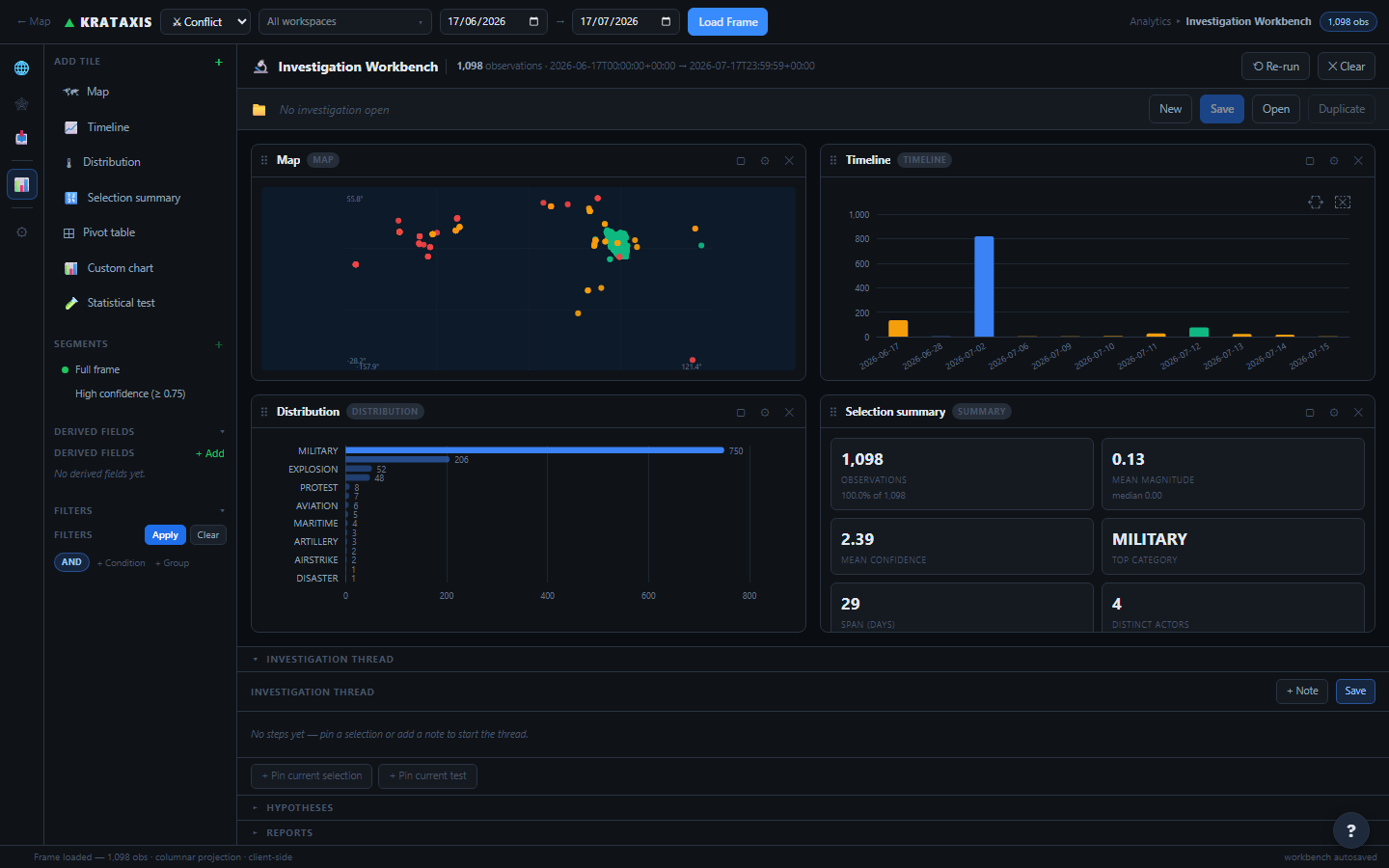
An investigation isn't a separate place so much as a way of working — and it spans two complementary surfaces:
| Surface | What it's for | Where |
|---|---|---|
| Investigation Workbench | Interrogate fused intelligence as data — slice it, cross-filter it, run tests, record a thread of steps, track hypotheses, and save the whole line of work. | Analytics → Workbench |
| Structured Analysis panel | Apply formal analytic techniques — competing hypotheses, key-assumptions checks, indicator matrices, pattern and fusion views. | The 🧠 Analysis button in the header |
The two work together: the Workbench is where you explore and assemble evidence; the Structured Analysis panel gives you disciplined methods to weigh it. Most investigations use both.
What makes it an "investigation"
Three properties separate an investigation from idle clicking around:
- It's saved. An investigation captures your data scope, your tile layout, your filters and segments, the thread of steps you took, and the hypotheses you tracked — so you (or a colleague) can reopen it exactly as it was.
- It's reproducible. Because the scope and steps are recorded, a finding can be re-run and checked rather than taken on trust — the same reason a lab experiment publishes its method, not just its result.
- It's publishable. A completed investigation can be promoted to a formatted report with its evidence attached — the end product you actually brief from.
The shape of an investigation
A typical line of work:
- Frame the question and set a scope (workbench, workspace, date range) in the Workbench.
- Explore — load the frame and use tiles (map, timeline, distribution, pivot, charts) to slice the data; cross-filter to narrow toward what matters.
- Test — run statistical tests and structured techniques against what you're seeing.
- Record — pin the steps that matter to the investigation thread, and capture candidate explanations in the hypothesis register with evidence attached.
- Decide — set a verdict on each hypothesis when the evidence is defensible.
- Publish — promote the investigation to a report.
Steps 4 and 5 are what most distinguish this from ordinary dashboard work: the thread and the register force your reasoning into the open, where it can be checked — by a colleague today or by you in six months, when you've forgotten why you concluded what you did.
Where the detail lives
The mechanics of the Workbench — frames, tiles, cross-filtering, derived fields, filters and segments, statistical tests, the investigation thread, the hypothesis register, and saving/sharing/reporting — are documented in depth in the Investigation Workbench manual. The formal techniques are covered in Structured Analysis.
This article is the orientation; those two are the how-to.
Where to next
- Structured Analysis — the formal analytic techniques in the 🧠 Analysis panel.
- The Investigation Workbench manual — the full how-to for interrogating data and recording a finding.
- Credibility & Validity — the grading your evidence rests on.